\
150. Mose Allison: Back Country Suite (Blues)
(Mose Allison) 1957
151. Dexter Gordon: Love for Sale
(Cole Porter) 1962
152. The Jay and Kai Trombone Octet: Night In Tunisia
(Dizzy Gillespie) 1956
153. Del Close and John Brent: Basic Hip
(Del Close-John Brent) 1959
154. Joe Morello Quartet featuring Art Pepper: Yardbird Suite
(Charlie Parker) 1956
155. Sonny Rollins: St. Thomas
(Sonny Rollins) 1956
156. Moondog: Chaconne in G Major
(Moondog) 1977
157. The Modern Jazz Quartet: Django
(John Lewis) 1954
158. The Jimmy Giuffre 3: The Train and the River
(Jimmy Giuffre) 1956
159. Charles Mingus: Better Git It In Your Soul
(Charles Mingus) 1959
160. Thelonious Monk: Misterioso
(Thelonious Monk) 1948
161. Miles Davis: So What
(Miles Davis) 1959
162. John Coltrane: My Favorite Things
(Richard Rodgers-Oscar Hammerstein) 1960
_________________________________________________________________________________________________________________________
“Basic to hip is the concept of digging: to dig. Mr. Geets Romo, how would you define ‘dig’?”
“Well, you know, man, like when you dig something.”
-- Del Close and John Brent, “Basic Hip”
Actor and satirist Del Close, in his improvised collaboration (with actor John Brent), How to Speak Hip, explored the innate difficulties of the terminology applied to music and culture within the fifties jazz world (and within mass media understandings of ‘hip culture’). While the singles-oriented rock and roll of the period was splintering into countless subgenres still defined by the catch-all term rock and roll, jazz was splitting into camps with ever-evolving and ever-more-confusing names, most often defined by how they differed from the jazz that had preceded them: (be)bop, post-bop, cool jazz, East Coast, West Coast, chamber jazz, the Third Stream. All of these were lumped together by the post-war, pre-JFK press into a catch-all term of their own: modern jazz.
Modern Jazz, a term almost never used today, was the shorthand for post-Swing (which was still, in some quarters, synonymous with “popular music”), post-World War II jazz that was not traditional, Dixieland jazz (as practiced still, in the fifties, by Louis Armstrong and dozens of professional and amateur musicians). Modern jazz was one of the first, if not the first, movement in popular music to define itself by its inaccessibility to the mainstream, in contradistinction to traditional or Dixieland jazz; Chuck Berry sang, in “Rock and Roll Music”, “I got no kick against modern jazz / Unless they try to play it too darn fast / Lose the beauty of the melody / Until it sounded like a symphony.” Indeed, in the world of modern jazz, building on the achievements of Charlie Parker (speed, unusual and difficult harmonic structures) and Duke Ellington (ambitious, thematic compositions and writing to the strengths of individual virtuoso soloists) through to the overt (The Modern Jazz Quartet) and covert (Charles Mingus) aspirations to symphonic complexity, these were often the very points of the existence of modern jazz. Modern jazz became, in the world of the popular press, along with beat poetry, recreational drugs, bongos, and berets, one of the central accoutrements of beat (more likely rendered “beatnik”) culture.
Jazz traditionalists separated themselves from the growing movement: no less than Louis Armstrong parodied Dizzy Gillespie in song, deriding “flatted fifths” while wearing a beret, and Tommy Dorsey accused the progenitors of bop of being communists. As often would prove the case in the popular culture to come, the outsider form termed modern jazz, would eventually provide the cultural norm; what most contemporary listeners consider jazz is not Dixieland nor swing, but the work of the bop and post-bop masters, Parker and his acolytes, particularly the four major figures: Thelonious Monk, Miles Davis, John Coltrane, and Charles Mingus.
With the introduction of the long-playing record in 1948, jazz composers and performers could now record, in their entirety, their lengthy compositions, thus pushing jazz farther from the popular singles/teenage audience. Furthering this separation was the total non-danceability of Parker-influenced bop: signs at Birdland and other jazz clubs appeared, emphatically proclaiming “No Dancing”. Bop, as practiced by Parker, was an intellectual form, demanding to players and listeners alike. While often blinding in its speed, it was subtle in its execution, and required classical-music-like concentration in order to be played or appreciated in full, a tall order for popular music listeners of the day, and one to which its creators did not choose to pander. As the central conceit of Del Close’s “Basic Hip” suggests, modern jazz doesn’t need to be explained: “In other words, the phrase ‘I dig’ not only means ‘I understand’, but ‘I am a special sort of person who understands in a very special sort of way.’”
It is tempting, then, to associate modern jazz with earlier artistic movements termed modernist. Certainly, its difficulty and often seemingly abstract quality, prompted the untrained to liken this jazz to Jackson Pollock’s paintings, The Waste Land, and Stravinski’s Rite of Spring. And a case could be made that, in terms of intentional elitism, the modernists of jazz share with their literary forbears an affinity for complex allusions to earlier work (dropping bars or themes from the classical canon, popular song, and Dixieland standard into their compositions with equal ease), but the comparison strains under further scrutiny. Mingus’s and Coltrane’s work, particularly, are better likened to the later works of T.S. Eliot (Mingus, late in life, toyed with creating a musical version of Eliot’s Four Quartets, and enlisted Joni Mitchell to assist in that very purpose), attempting to rebuild a structure out of the broken “shards” of the past, with Mingus eventually returning to quasi-classical structures and themes (Pre-Bird) that he first explored as a teenage composer and Coltrane relentlessly pursuing spiritual aims within his music.
What jazz musicians and composers drew from the innovations of Charlie Parker, in addition to a propensity for lightning-fast playing and heroin addiction, was a questing for the next big development, a pushing against any and all barriers that produced the most fertile period in jazz history, one in which all genres of jazz were intermingled, in the best of the era, in bewildering and sublime displays of both technique and soulfulness. It is not an accident that many of the major figures of the fifties apprenticed with Parker or Dizzy Gillespie (“bop’s chief organizer”, as he is called in Ken Burns’ Jazz). It is also not an accident that many of the leading figures were finally catching up to the compositional innovations of Duke Ellington, himself still producing challenging works throughout the fifties; Ellington’s unconventional chord voicings and his trademark of providing solo space within otherwise tightly-structured compositions inspired Monk, Mingus, and other bop veterans not only to cover standards in Parker-like deconstruction, but to write their own ambitious pieces.
Initially, the post-Parker jazz landscape divided itself into East Coast and West Coast schools, much as hip-hop would do forty or so years later. East Coast jazzers favored fast-played, technically dazzling emulations of Parker; West Coast jazzers, who were predominantly, but not exclusively, white, preferred to play cool – laid back, but still harmonically complex, often including motifs and arrangements drawn from classical music or the late-period jazz-classical fusions of Artie Shaw or Stan Kenton. The era’s best musicians (especially Mingus and Davis) straddled these lines, eventually obliterating them. Parker’s greatest pupils, the saxophonists Art Pepper and Sonny Rollins carried Parker’s legacy in different ways, Pepper as stylistic imitator, Rollins continuing Parker’s sense of the innate possibilities of jazz (and particularly, the saxophone) as tool for personal exploration and expression. Tenor saxophonist Dexter Gordon, a contemporary of Parker’s in the early bop era, took Lester Young’s influence and big, bold tone through the post-bop era and, in turn, influenced John Coltrane, who would prove to rival Parker in influence and popularity.
In the wake of Parker’s death in 1955 at age thirty-four, from the accumulated damage of years of substance abuse, the jazz innovation most lauded in the jazz press was The Third Stream. The Third Stream, a term coined by composer Gunther Schuller, described a music that was neither jazz nor classical music, but combined and “required proficiency” in both. Schuller was adamant that “classical music played on jazz instruments” and “jazz played by traditionally classical instruments” were not Third Stream jazz. Today, the term is often applied to the collaborations of Miles Davis and arranger Gil Evans, to the orchestral works of Charles Mingus, and to the “Bach meets bop” approach of John Lewis’s Modern Jazz Quartet. A rather more efficient and descriptive term is “chamber jazz”, that is, jazz that, like chamber music, is played by small ensembles, often drawing inspiration from classical (usually baroque) music.
While the Third Stream momentarily enchanted some critics, few works found great popular success, although Miles Davis and Gil Evans’s Sketches of Spain and the elegant Modern Jazz Quartet did. The MJQ, all veterans of Dizzy Gillespie’s big band usually wore tuxedos in performance and didn’t interact with their audiences, aspiring to not only classical forms, but also classical decorum, often exhibiting, even in their tribute to Django Reinhardt, a humorlessness most foreign to jazz. Jimmy Giuffre, a West Coast proponent of the Third Stream, called his music “blues-based folk jazz”; Giuffre’s trio, which included guitarist Jim Hall, was a major influence on the British folk-blues revival, and particularly on guitarist Davy Graham. J. J. Johnson, a trombonist who had played with Parker and with Miles Davis, was also classed among the Third Stream musicians, though his most popular success occurred with a series of Parker-influenced big band recordings with fellow trombonist Kai Winding, and, at times, up to six other trombonists; their reworking of Gillespie’s “Night in Tunisia” is perhaps that song’s definitive version. Ironically, the most perfect fusion of classical form and jazz spirit, including its humor, belonged to Moondog, a blind, homeless, New York composer who dressed in homemade Viking-inspired clothing and whose compositions, like those of Thelonious Monk, bear an instantly recognizable signature and a joyousness redolent of Dixieland.
While the Third Stream and chamber jazz aspired to a pseudo-European seriousness of purpose, Mississippi-born singer-songwriter-pianist Mose Allison was moving in the opposite direction, embracing the form and humor of the blues, as filtered through the fierce technique of bop. Allison’s major influences were Armstrong, Hoagy Carmichael, Ray Charles, and Hank Williams, and his laconic, verbally-complex, self-aware, if not self conscious, blues songs went on to influence more rock performers than jazz ones: Bob Dylan, the Who, the Yardbirds, Van Morrison, Tom Waits, and Elvis Costello among them.
The figures most difficult to classify generically, finally, are the best remembered of the period. The works of Monk, Mingus, Davis, and Coltrane, among non-jazz listeners today, are the figures most often heard, and their albums the most frequent to appear in non-jazz collections. Pianist-composer Thelonious Monk appeared at the height of bop in the late forties, seemingly fully-formed as personality and composer, and continued until the late sixties, often re-recording the same set of highly-logical, mathematically-complex, eminently catchy and humorous compositions until the general public caught up enough to appreciate his percussive, impressionistic style. Bassist-composer Charles Mingus, who apprenticed with Armstrong, Ellington, and Lionel Hampton, wrote and recorded prodigious amounts of material from the forties to the seventies, drawing from nearly all of jazz’s styles within his sprawling, episodic compositions and “group improvisations.” Accused by the press of writing works that were too cerebral, Mingus responded with the album Blues and Roots, the songs “Haitian Fight Song” (from The Clown) and “Better Git It in Your Soul” (from Mingus Ah Um), shattering fusions of gospel, blues, and hard bop that convinced all doubters of Mingus’s pedigree in all forms of American music.
Miles Davis, impeccably dressed and personally unapproachable, technically brilliant and taciturn, who began with Parker, was one of the first players of cool jazz, exhausted the possibilities of the Third Stream, developed modal (non-chord-change-based jazz) from ideas of Mingus’s and pianist Ahmad Jamal’s, perfected hard bop, essentially invented jazz-rock fusion, and ended his career with popular, though critically-derided pop-jazz that birthed today’s smooth jazz. He is, for many people, the face of jazz. Kind of Blue, the highest selling album in jazz history, with “So What” as its opening track, is usually the first jazz album recommended to non-jazz listeners who want to explore the genre.
In many ways, the jazz of the fifties represents a generation of musicians coming to terms with the legacy of Charlie Parker, and with the rapidly-changing role of jazz in popular culture. Saxophonist-composer John Coltrane, who had played with Parker and Monk became a part of Davis’s quintet (and appeared on Kind of Blue) before taking Parker’s mantle as the guiding force of jazz. Stylistically, he drew speed and fearsome technique from Parker, but his “sheets of sound” style was overpowering where Parker’s was precise, substituting metallic howls of ecstacy and agony for Parker’s intellect and humor. His covers, especially of the Rodgers and Hart “My Favorite Things”, were not so much deconstructions or reinventions as explorations, pushing the harmonic and rhythmic structures of songs through endless inventive variations and straining the songs’ structures close to, but not past, the breaking point. His relentless quest, eventually giving birth to free jazz, and inspiring jazz’s infatuation with India, mysticism, and Afro-centrism, was ultimately, the truest heir to Parker’s spirit, harnessing its technique to his own spiritual concerns, while moving jazz further still from the mainstream of American popular music, and, closer, without the stated pretensions of the Third Stream or chamber jazz, to something like art.
____________________________________________________________________________________________________________________________________________________________________________________
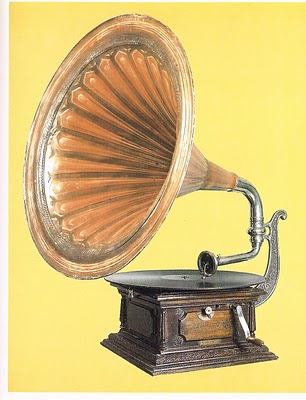
A History of Recorded Popular Music: a 1200 artist, 1200 song narrative of popular music, arranged in playlist form, with commentary, video, and the occasional apology.
Showing posts with label Bebop. Show all posts
Showing posts with label Bebop. Show all posts
Friday, April 9, 2010


Wednesday, February 24, 2010
Volume Three: Jumpin' with Symphony Sid - Swing to Bop
47. Hal McIntyre and his Orchestra: This Is the Army, Mr. Jones
(Irving Berlin) 1942
48. Spike Jones and his City Slickers: In Der Fuhrer’s Face
(Oliver Wallace) 1942
49. Mickey Katz and his Kosher Jammers: Bagel Call Rag
(Billy Meyers-Elmer Schoebel-Jack Pettis) 1952
50. Duke Ellington and his Orchestra: Mood Indigo
(Duke Ellington-Irving Mills-Barney Bigard) 1957
51. Count Basie Orchestra: The Kid from Red Bank
(Neal Hefti) 1957
52. Stan Kenton and his Orchestra: Artistry in Rhythm
(Stan Kenton) 1944
53. Gene Krupa and his Orchestra, featuring Anita O'Day: Opus No. 1
(Sy Oliver) 1946
54. Billie Holiday with Tony Scott and his Orchestra: God Bless the Child
(Billie Holiday-Arthur Herzog, Jr.) 1956
55. Frank Sinatra: One for My Baby
(Harold Arlen) 1958
56. Ella Fitzgerald: Too Darn Hot
(Cole Porter) 1956
57. Nat King Cole Trio: Straighten Up and Fly Right
(Nat King Cole-Irving Mills) 1944
58. Les Paul and Mary Ford: How High the Moon
(Morgan Lewis-Nancy Hamilton) 1951
59. Harry "The Hipster" Gibson: Who Put the Benzedrine?
(Harry Gibson) 1947
60. Charlie Parker with Strings: Autumn in New York
(Vernon Duke) 1952
61. The Quintet: Perdido [live]
(Juan Tizol) 1953
62. Dizzy Gillespie: Caravan
(Juan Tizol) 1954
63. Bud Powell: Get Happy
(Ted Koehler-Harold Arlen) 1950
64. Art Tatum: Sweet Lorraine [live]
(Cliff Burwell-Mitchell Parish) 1955
65. Lester Young with the Oscar Peterson Trio: Stardust
(Hoagy Carmichael-Mitchell Parish) 1952
66. The George Shearing Quintet: Jumpin’ with Symphony Sid
(Lester Young) 1949
_________________________________________________________________________________________________________________________
"What makes bebop legitimate is the fact that when it was done, it was illegitimate."
-- Matthew Shipp
Much of the sentimental wartime pop produced in the early nineteen forties falls outside the purview of this project; early rock and roll was in many ways a reaction against the music of the period and much of the most famous pop of the period (Glenn Miller, the Andrews Sisters) had a tendency to be both repetitive and vapid, although, on occasion, the humor and creativity of early jazz and hot swing did show through. As examples of songs of the period, Miller veteran Hal McIntyre’s recording of Irving Berlin’s patriotic “This Is the Army, Mr. Jones”, and, especially, Spike Jones’s gloriously obnoxious “Der Fuhrer’s Face” (from a Disney short of the same name) manage to balance humor, swing, and patriotism in a blend not often found in agit-prop songs. In a similar vein, the unjustly overlooked Mickey Katz (father of Joel Grey and grandfather of Jennifer Grey), who had contributed glugging sounds to a series of Jones’s parodies, produced Yiddish song parodies from the late the forties until the early sixties, combining a trad. Jazz / Swing fusion with Klezmer breaks he termed “Yiddish jazz.” The members of his “Kosher Jammers” were mostly veterans of the Goodman and Dorsey bands and his “Bagel Call Rag” features some astonishing breakneck soloing from Katz on clarinet and Mannie Klein on trumpet.
The war years were a period of very rapid change in popular music, due not only to the war itself, but to the American Federation of Musicians undertaking a recording strike, prompted by disputes of record royalties, from August, 1942, until late 1944. Musicians could not record (except on V-Discs, recordings made especially for use by the armed forces), although vocalists could and did. In an era in which swing bands balanced their repertoires between swinging instrumentals and softer, sweeter vocal tunes, the effect of the recording ban was profound: by the close of the ban, vocalists had become central to the American popular recording industry, a condition that has not changed since the forties. Also, freed from the constraints of commercial recording, many musicians focused on more adventurous playing; it’s generally agreed that bebop, with lengthy, complicated solos replacing full band or sectional playing of a song’s melody, developed during the recording ban.
Thus, in the post-war era, there are three distinctive major stylistic changes to swing-based jazz: the rise of non-danceable, intellectually and artistically-rigorous small group bebop (which effectively distanced jazz from mainstream pop), the further development of more compositionally complex full-band jazz (the golden age of Duke Ellington’s and Count Basie’s bands, and the experimentation of Stan Kenton), and what is usually thought of as the Golden Age of Traditional Pop Singing – solo jazz-inflected vocalists influenced by Armstrong and by Billie Holiday, singing selections from the Great American Songbook (the Gershwins, Cole Porter) in lightly swinging arrangements by former swing musicians (Nelson Riddle, especially, but also Billy May, Gordon Jenkins, and many others).
These stylistic changes were accompanied by very rapid technological changes – particularly the introduction of magnetic tape and Les Paul’s experimentation with tape-based overdubbing (“How High the Moon” features only Les Paul’s overdubbed guitars and Mary Ford’s overdubbed vocals). Further, the introduction of the long-playing album and the 45-rpm single in 1948 accompanied the boon in post-War incomes in America. Increased disposable income meant increased money that could be spent on entertainment; singles gradually becoming the province of casual listeners and, especially, teenagers while lps focused on classical, jazz, and “adult” pop. The greater track times available on lps made the reproduction of lengthy bebop performances on disc a reality and allowed concept-based albums by singers (particularly the classic Capitol Sinatra albums of the fifties) possible.
Bop grew out of earlier swing-based precursors, especially the rhythmic and harmonic innovations of Coleman Hawkins and Charlie Christian (both included on Volume Two): improvising complex melodic lines over a standard’s chord changes until the original melody is either unrecognizable or disappears completely. The bop musicians’ reliance on the same standards the pop vocalists were recording and re-recording, often songs from the previous twenty years that had initially been written for Broadway, further solidified the sense that these songs were the high point of uniquely American art – “Stardust” by Lester Young, “Sweet Lorraine” by Art Tatum, “Get Happy” by Bud Powell. By taking songs that were familiar to audiences and reinventing them harmonically and melodically, bop soloists created an effect similar to that already present in blues and much later evident in hip hop – the presentation of a singular individual vision against a pre-existing framework, resulting in the equivalent of modernist (and post-modernist) intertextuality.
Saxophonist Charlie Parker and trumpeter Dizzy Gillespie are the recognized fathers of the genre. Parker’s favorite among his own recordings was the Bird with Strings album, which saw him playing more conventionally than his more critically-lauded recordings while the live recording of “Perdido” features him (billed as Charlie “Chan” for contractual reasons), Gillespie, Charles Mingus, Max Roach, and Bud Powell as “The Quintet.” Parker’s influence on jazz and, in particular, on the growing pre-eminence of the saxophone as the jazz instrument cannot be understated. As Mingus titled a composition, “If Charlie Parker Were a Gunslinger, There’d Be a Lot of Dead Copycats.”
Similar techniques were being employed by the pop vocalists; Billie Holiday’s technique of lagging behind the beat and ‘acting’ the song’s lyric was a profound influence on all pop singing to follow: Frank Sinatra named her as his greatest vocal influence (and her influence is clearly heard in the vocals included here by both Sinatra and by Anita O’Day), while Nat King Cole and Ella Fitzgerald extend Louis Armstrong’s scat improvisation on the melody into swing territory.
The recording industry had changed massively by the end of the forties: technology allowed for greater innovation while the gulf between jazz and pop started to widen into one that would never again be closed. As pop became big business again, the album became the venue of “adult” artists and singles started to be where novelties, dance records, and unproven artists found their outlet, thus setting the stage for the rhythm and blues and rock and roll revolutions to come.
____________________________________________________________________________________
Subscribe to:
Posts (Atom)
Subscribe To


 Posts
All Comments
Posts
All Comments